Skip to content
Surgical Candidates
First and foremost, it is important to know that a tummy tuck (or abdominoplasty, in the plastic surgery lingo) should never be viewed as a procedure to lose weight. It is a way to contour the body. Women who have had children are well aware of changes that occur with their abdominal wall: the skin stretches and leaves permanent marks, fat collects around the lower trunk and is saggy, and no matter how much you diet or exercise, it seems that the tummy always “pooches.” These are very characteristic changes of the tummy after the tremendous pressure exerted by the growing fetus. These various stigmata of pregnancy are often best treated with this procedure.
Women and men who undergo massive weight loss (greater than 30 to 50 lbs.) may exhibit dramatic changes in their abdominal wall. This scenario is different, however. Instead of excessive fat, there is a relative “deflation,” or loss of fat. This is characterized by more loose, flabby skin and stretch marks. Tummy tucks can also be beneficial for these patients (see Circumferential Abdominoplasty).
Patients who intend to lose a lot of weight should postpone the surgery. Also, women who plan future pregnancies should wait, as vertical muscles in the abdomen that are tightened during surgery can separate again during pregnancy. Previous abdominal scarring may preclude some patients from being candidates for tummy tucks – a detailed consultation with Dr. Ha will help determine this.
The abdominal wall is composed of many layers: skin, fat, fascia (strong layer), muscle, etc. Skin normally has elasticity – up to a certain point. This means that you can pull on the skin and when you let go, the skin will recoil back to its normal shape. However, if the skin is stretched beyond its inherent elasticity, it will no longer recoil back to its normal shape, and “stretch marks” will be left behind. Stretch marks should be viewed as permanent internal injury of the skin. There are many products/lasers/creams claim to reverse or remove stretch marks – none are effective. To date, plastic surgeons or dermatologists do not have an easy solution to remove these, except for surgery.
Fat is located just beneath the skin. The lower trunk is where most women tend to accumulate fat – which is often resistant to exercise or weight loss. The layer of the tummy that provides the most strength and shape is the fascia and muscles. The stretching of these tissues during pregnancy cause the “pooching” that occurs afterward. A separation of the vertically paired abdominal muscles can occur in the midline creating a weak spot (“diastasis”). Even performing sit-ups or other exercises to strengthen the muscle are often not effective to eliminate the “pooch” – this is because the fascia and muscles have been irreversibly stretched and thinned.
Surgical Procedure
The tummy tuck addresses all of these layers. First, an incision is created from the pubic bone centrally, angling upward and outward towards the hip bone. The skin and fat are separated from the underlying muscle and fascia. The excess skin and fat are excised (thus, the stretch marks are removed). Usually the portion below the navel is ultimately removed. The muscles and fascia are then re-tightened (thus repairing the “diastasis”) to restore the normal flat shape of the abdomen. The navel is repositioned, and the skin is repaired.
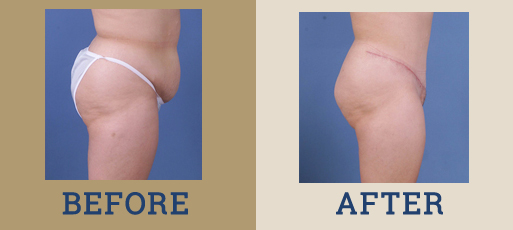
The surgery does require a lengthy scar at the very bottom of the abdominal wall, extending from one hip bone to the other. However, this incision is well hidden in most bikini or panty lines. Wearing a 2-piece bathing suit is usually not a problem.
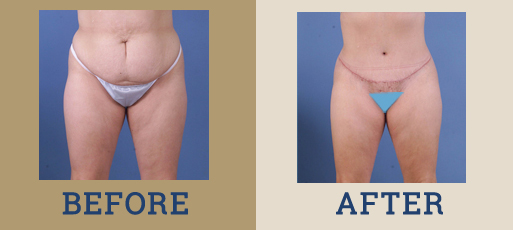
The results are often life-changing – flat and tight abdominal wall with restoration of the waistline. Patients regain their confidence as clothes fit better, swimsuits and bikinis can be worn, and stretch marks and the classic “pooch” are eliminated. The surgery lasts up to 3 hours and the procedure is relatively safe, but it is important to find an appropriately trained plastic surgeon. With proper diet and exercise you will be able to enjoy the results of your surgery for many years.
Recovery
The first 23 hours are usually spent in an overnight facility for recovery. For the first few days after surgery, there may be some swelling in the abdominal area. Drains placed during surgery will be cared for and are required for 1 to 2 weeks. Patients will spend the first week keeping flexed at the hips to avoid separation of the skin repair and to minimize discomfort. However, it is important to become mobile and walking soon after surgery. Dressings will be worn for approximately 1 week and sutures will be removed at that time.
A compressive garment or abdominal binder will be worn for 6 weeks to help reduce swelling, maintain the contour, and to minimize discomfort. It may take up to a month before you can resume all normal activities including exercising, and your body may need up to a year to completely adapt to the new abdominal configuration.
Scar management will begin shortly after sutures are removed. Scars are typically red and thick for several months, but will eventually mature and fade by 9 to 12 months post-op.